
Introduction
If the last five years were about where we work (the shift from office to home), the next five years will be about how we work.
The debate over “Return to Office” mandates is largely settling into a hybrid reality. But beneath the surface, a much deeper transformation is happening. We are moving away from the industrial-era model of “time sold for money” toward a result-oriented economy powered by autonomous AI agents and asynchronous collaboration.
For professionals, students, and business leaders, the rules of the game are changing. The skills that got you hired in 2020 might not keep you employed in 2026. This article explores the five critical trends shaping the future workforce and provides a roadmap for staying relevant in an age of rapid disruption.

Trend 1: The Rise of “Asynchronous” Work
The 9-to-5 workday was invented for factory lines where everyone had to be present simultaneously to keep the conveyor belt moving. In the knowledge economy, this synchronization is often a productivity killer.
What is Asynchronous Work? It means work doesn’t happen at the same time for everyone. You send a message or record a video update, and your colleague in a different time zone responds when they are most productive.
-
The Shift: Companies are moving away from “Presenteeism” (being seen in a seat) to “Impact” (what did you actually ship?).
-
The Tool: Video messaging tools like Loom and collaborative docs like Notion are replacing the dreaded “1-hour status meeting.”
-
Your Move: Learn to communicate clearly in writing. If you can explain complex ideas via text or recorded video without needing a live meeting, you become invaluable to global teams.
Trend 2: From AI Chatbots to “AI Agents”
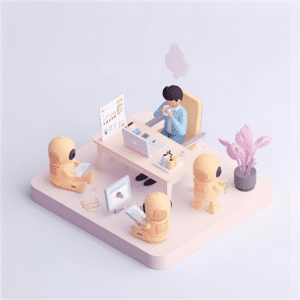
We are currently in the era of AI Chatbots (like ChatGPT), where you chat with a bot, and it gives you text. We are entering the era of AI Agents.
The Difference:
-
Chatbot: You ask, “How do I book a flight?” It gives you instructions.
-
Agent: You say, “Book a flight to London for under $600 next Tuesday,” and the Agent goes to the website, selects the flight, enters your details, and sends you the confirmation to approve.
In 2026, we will not just talk to AI; we will delegate to it. This means the ability to manage and orchestrate AI agents will become a high-demand management skill.
Trend 3: The “Human-Only” Skill Premium
As AI takes over technical coding, basic copywriting, and data analysis, the value of “Hard Skills” will fluctuate. However, the value of “Soft Skills” (which we should rename “Power Skills”) is skyrocketing.
What Cannot Be Automated?
-
Empathy & Conflict Resolution: An AI can write a polite email, but it cannot navigate the emotional nuance of a disgruntled high-value client or resolve a feud between two department heads.
-
Strategic Curation: AI can generate 100 marketing ideas in a minute. A human is needed to say, “99 of these are bad, and this one fits our brand voice.”
-
Ethical Judgment: Deciding if we should do something, not just how to do it.
Career Advice: If your job involves strictly following a manual, you are at risk. If your job involves synthesis, strategy, and human connection, you are safe.
Trend 4: The Micro-Credential Revolution
The four-year degree is losing its monopoly on education. Technology moves too fast for university curriculums to keep up. By the time a “Social Media Marketing” syllabus is approved, the algorithms have changed three times.
The New Normal: Employers are increasingly looking for “Micro-Credentials” and portfolios.
-
Instead of a generic degree, a candidate might show a Google Certificate in Data Analytics, a specific certification in Cyber Security, and a GitHub portfolio of AI projects.
-
Continuous Learning: The concept of “finishing school” is dead. You must view education as a subscription, not a one-time purchase.
Trend 5: Cybersecurity as a Culture
As we discussed in our guide on Cybersecurity, the decentralized workplace introduces massive risks. With employees working from Bali cafes and home offices, the traditional corporate “firewall” no longer exists.
In 2026, security will not just be the IT department’s problem. Every employee will be expected to have “Security Fluency”—understanding phishing, data privacy laws, and secure data handling. Companies will hire based on trustworthiness and security hygiene as much as technical ability.
Conclusion: Adapt or Stagnate
The future of work is not a distant sci-fi movie; it is happening in the Slack channels and Zoom rooms of today.
The winners of this shift will not necessarily be the best coders or the fastest typists. They will be the Adaptable Integrators—the people who can work seamlessly with AI, communicate asynchronously across borders, and bring deep human empathy to a digital world.
The Question to Ask Yourself: Look at your current daily tasks. Which ones are “Robot Work” (repetitive, data-heavy) and which are “Human Work” (strategic, creative, relational)? Your goal for 2026 is to hand the robot work to the robots and double down on being human.