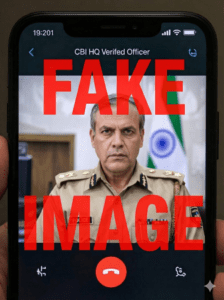
Stop. Take a deep breath.
If you are reading this article, you probably just received a video call from someone claiming to be a “CBI Officer,” “Mumbai Police,” or “Customs Official.” They may have sent you a letter on WhatsApp that looks like an official Arrest Warrant or Asset Seizure Order.
Here is the truth: “Digital Arrest” does not exist in Indian Law.
The Supreme Court and Prime Minister have explicitly stated that no police agency in India can arrest you over a video call.
However, the documents they send look terrifyingly real. They use official logos, stamps, and signatures. In this guide, we will analyze a fake warrant vs. a real legal process so you can spot the scam immediately.
The “3-Second” Verification Test
If you are on the call right now, check these three things immediately. If ANY of these are true, it is a scam. Hang up.
-
Are they on WhatsApp or Skype? Real police never use public video calling apps for official investigations. They use official physical summons.
-
Are they asking for money to “verify” your funds? Real police never ask you to transfer money to a “Supervisory Account” or “RBI Safe Account” for verification.
-
Are you “Digital Arrested”? Does the document say you are under “Digital Custody” or “Online Surveillance”? This legal term does not exist.
How to Verify the “Fake Warrant” (Look for These Errors)
The scammers often send a PDF or image file on WhatsApp. Do not delete it; it is evidence. But do not believe it. Here is how to spot the fakes:
1. The “Logo Salad”
Real government documents are boring. They usually have one header (e.g., “Central Bureau of Investigation”).
The Scam Version: The fake warrants often paste every logo possible to scare you. You will often see the CBI logo, FBI logo, Interpol logo, and Indian Supreme Court logo all on the same page.
-
Verification: Real Indian warrants do not feature foreign agency logos (like the FBI) unless it is an international extradition case (which wouldn’t be handled via WhatsApp).
2. The Language of “Immediate Seizure”
Fake warrants use aggressive, urgent language to induce panic.
-
Fake Text: “Your assets will be seized within 2 hours if verification is not completed.”
-
Real Law: Seizing assets requires a long legal process involving court orders and physical notices. It never happens “in 2 hours” over a chat app.
3. The Stamps and Signatures
Scammers use low-quality .png images of stamps found on Google Images.
-
The “Blue Seal” Trick: Look closely at the round blue stamp. Does it look pixelated? Is it perfectly straight? Real physical stamps are often slightly smudged or rotated.
-
The Signature: Often, they sign it as “Officer George” or simple names. Real warrants list the Full Name, Rank, and Badge Number clearly.
Why They Use “Skype” (The Technical Trick)
You might wonder, “Why do they look like they are in a real police station?”
Scammers use Green Screens or authentic-looking backdrops. They wear uniforms (often bought online).
-
The Studio: They operate from “Scam Compounds” (often in Southeast Asia) designed to look like offices.
-
The “Official” ID: They will flash an ID card at the camera for 1 second—too fast for you to read, but enough to scare you.
The Giveaway: Ask them to email you from their official @gov.in or @nic.in email address.
-
Scammer Response: “Security protocols prevent email.” (This is a lie).
-
Real Officer Response: They will have an official government email.
Step-by-Step: What to Do If You Are targeted
If you are currently on a call or just hung up:
-
Do Not Pay: Once money is sent via crypto or mule accounts, it is very hard to recover.
-
Take Screenshots: Screenshot the officer’s face, the “warrant,” and the Skype/WhatsApp profile number.
-
Report to 1930: Dial 1930 immediately. This is the National Cyber Crime Helpline in India. They can freeze the transaction if caught early.
-
File a Complaint: Go to [suspicious link removed] and file a formal complaint under “Financial Fraud.”
FAQ: Is Digital Arrest Legal?
Q: Can the CBI arrest me on a video call? A: No. An arrest requires physical presence, a physical warrant, and an arrest memo signed by family or witnesses. Video call arrests are illegal and fake.
Q: They said my Aadhaar is linked to money laundering. How do I check? A: You cannot check “money laundering” status online, but you can check where your Aadhaar is used via the official UIDAI website history. Police will send a physical notice (Section 41A CrPC) if they actually need to question you.
Q: Is the ‘Supreme Court of India’ letterhead real? A: Scammers often forge Supreme Court letterheads. The Supreme Court does not issue arrest warrants directly to citizens via WhatsApp.
🛑 Author’s Note
I wrote this guide because I saw a family member panic over a similar call. Please share this article in your family WhatsApp groups—especially with parents and elderly members who are the primary targets of this scam.