Introduction
If you ask a software engineer, “Which language should I learn first?”, 9 out of 10 will give you the same answer: Python.
It is not the fastest language (that’s C++). It is not the language of the web browser (that’s JavaScript). Yet, Python has conquered the world. It powers everything from the Netflix recommendation algorithm to NASA’s image processing and the very AI models (like ChatGPT) that are revolutionizing our industry.
But why? And more importantly, how do you actually start?
### The Moment I Ditched C++ for Python When I was first learning to code, I spent an entire afternoon trying to write a program in C++ that simply read a text file and counted the words. I battled with memory management, compilation errors, and missing semicolons for 4 hours.
Then, a mentor showed me how to do the exact same thing in Python. It took 3 lines of code:
# The code that changed my mind
with open(‘data.txt’, ‘r’) as file:
data = file.read()
print(len(data.split()))
That was my “Aha!” moment. In my daily work now, I don’t use Python because it’s “trendy.” I use it because it respects my time. If I need to automate a spreadsheet report or scrape a website for data, I can finish the script in 15 minutes and move on with my day.
This guide is for the absolute beginner. We won’t bore you with computer science theory. Instead, we’ll explain why Python is the Swiss Army Knife of the digital age and give you a roadmap to writing your first script today.
1. The “Readability” Revolution
The biggest barrier to coding is usually the syntax (the grammar of the code). Most languages require you to worry about semi-colons ;, curly braces {}, and memory management.
Python removes the clutter. It was designed by Guido van Rossum with one goal: Readability.
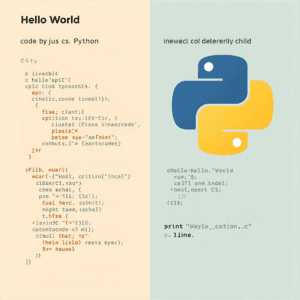
Compare this Logic:
-
Other Languages: “If (x) is true { then execute function_y(); }”
-
Python:
if x is True: function_y()
Because it reads like English, you spend less time fighting the computer and more time solving the problem. This makes it the perfect entry point for non-programmers, marketers, and data analysts.
2. What Can You Actually Build? (The 3 Pillars)
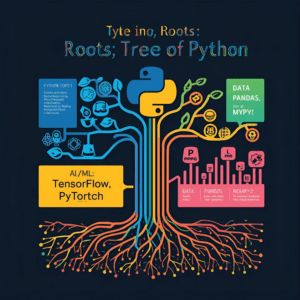
Python is general-purpose, but it dominates in three specific areas. If you want a career in any of these, Python is non-negotiable.
A. Data Science & Artificial Intelligence
This is Python’s “Killer App.” Libraries like Pandas (for data analysis) and PyTorch (for AI) are built almost exclusively for Python. If you want to analyze stock markets, visualize health data, or train a neural network, you use Python.
B. Web Automation (Scripting)
Hate copying and pasting data from Excel to a website? Python can automate that.
-
The Tool:
SeleniumorBeautifulSoup. -
The Use Case: Write a script that automatically logs into a website, scrapes the prices of flights, and emails you when they drop.
C. Web Development (Backend)
While JavaScript runs the “front” of a website (what you see), Python often runs the “back” (the database and logic).
-
The Tool:
DjangoorFlask. -
The Use Case: Instagram and Pinterest were largely built using Python because it allows for rapid development.
3. Your First Roadmap: From Zero to Hero
Don’t just watch YouTube videos. You must type code to learn code. Here is the most efficient path to learning Python in 2025.
Month 1: The Basics (Syntax)
-
Goal: Understand Variables, Loops, and Functions.
-
Project: Build a “Calculator” or a text-based “Adventure Game.”
-
Resource:
Automate the Boring Stuff with Python(A classic, free online book).
Month 2: Pick a Specialization
Don’t try to learn everything. Pick a lane.
-
If you like data: Learn the
Pandaslibrary. Download a spreadsheet of movie ratings and try to find the average score. -
If you like building things: Learn
Flask. Build a simple “To-Do List” website running on your local computer.
Month 3: The “Capstone” Project
Stop following tutorials. Build something unique.
-
Idea: A “Weather Bot” that texts you the temperature every morning using an API.
-
Why: This teaches you how to read documentation and debug errors—the two most important skills of a developer.
4. Setting Up Your Environment (Do This Now)
You don’t need fancy software.
-
Download Python: Go to python.org and get the latest version.
-
Get a Code Editor: Download VS Code (Visual Studio Code). It’s free and the industry standard.
-
Install Extensions: In VS Code, install the “Python” extension by Microsoft.
Congratulations. You now have the same setup as a Google Engineer.
Conclusion: Just Start
The best time to learn to code was 10 years ago. The second best time is today.
In an age where AI is automating routine tasks, the ability to control the AI (via code) is a superpower. Python is your wand. It is free, the community is helpful, and the career opportunities are endless. Open your text editor, type print("Hello World"), and see where it takes you.