Introduction
For the last 20 years, the deal between Google and websites was simple: You write content, Google ranks it, and users click on your link to read it.
In 2025, that deal is breaking.
With the rollout of AI Overviews (formerly known as SGE), Google now answers the user’s question directly on the search results page. If you ask, “What are the best running shoes?”, an AI summarizes the answer for you. The user never clicks a link.
For bloggers and business owners, this is a “Code Red” moment. The old tactics of stuffing keywords into a blog post are dead. To survive the “Zero-Click” era, you need a fundamentally new strategy.
This guide will teach you the new rules of SEO—how to optimize for humans and AI agents to ensure your traffic grows rather than disappears.
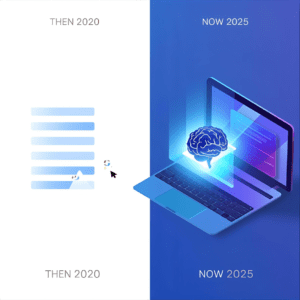
Caption: The evolution of Search: From “10 Blue Links” to “AI Answers.”
1. The New Reality: “Answer Engine Optimization” (AEO)
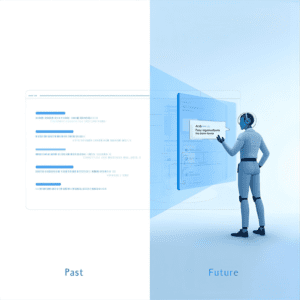
We are moving from “Search Engines” to “Answer Engines.” Your goal is no longer just to rank #1; your goal is to be the source that the AI uses to generate its answer.
How to Win:
-
Direct Answers First: Don’t bury the answer. If your title is “How to Fix Error 404,” the first paragraph should be the solution. AI loves concise, direct answers.
-
Structure Matters: Use clear
H2andH3headers. AI bots scan your headers to understand the logic of your article. -
Schema Markup: This is code that helps Google understand your content. Use a plugin like RankMath or Yoast to automatically add “Article” or “FAQ” schema to your posts.
2. E-E-A-T: The Only Metric That Matters
With AI tools like ChatGPT able to write infinite generic articles, Google is desperate for one thing: Human Experience.
Google’s ranking system relies on E-E-A-T:
-
Experience (Did you actually do it?)
-
Expertise (Do you know your stuff?)
-
Authoritativeness (Do others trust you?)
-
Trustworthiness (Is your site safe?)
Actionable Steps:
-
Stop “Ghost Writing”: Every post needs a real author with a bio.
-
Show Your Work: Don’t just list facts. Share personal stories. Instead of “Here are 5 tips for coding,” write “How I fixed a bug that cost me 3 days.” AI cannot hallucinate your personal life.
-
About Page: Ensure your About Us page is robust. It should list who you are and why you are qualified to give advice.
3. Keywords are Dead; Long Live “Topics”

In the past, you would write one article for “Best Laptops” and another for “Top Laptops.” Today, Google is smart enough to know those are the same thing.
The “Topic Cluster” Strategy: Instead of random posts, build a “web” of content.
-
The Pillar Page: A massive, 3,000-word guide on “Cybersecurity.”
-
The Cluster Pages: 10 smaller articles on “Password Managers,” “VPNs,” “Phishing,” etc.
-
The Links: Every cluster page links back to the Pillar page.
This tells Google, “We are experts on Cybersecurity.” It is exactly the strategy we are building on TechSocial.online.
### My Experiment: Searching for “Best Gaming Laptop” To understand how Google’s new AI Overviews are stealing traffic, I ran a test search this morning for “Best budget gaming laptop 2025.”
Here is what I saw:
-
The AI Answer: Google occupied the entire top half of the screen with a summary of specs, pros/cons, and direct price comparisons.
-
The Impact: I didn’t need to click on PCMag or The Verge. I got my answer without leaving Google.
What this means for us: As a website owner, this terrified me at first. But I realized that the AI didn’t answer the nuanced questions. It didn’t tell me “how the keyboard feels to type on” or “if the fan noise is annoying in a quiet room.”
My Strategy Shift: I am no longer writing “List of Specs” articles (the AI does that better). I am shifting entirely to “Hands-On Reviews.” If you can’t offer a personal opinion that an AI can’t scrape, you are invisible.
Caption: Topic Clusters build “Topical Authority,” which is harder for competitors to copy than a single keyword.
4. Technical SEO: The Foundation
You can write the best article in the world, but if your site is slow, Google will ignore it.
The 2025 Checklist:
-
Core Web Vitals: Your site must load in under 2.5 seconds.
-
Fix: Install a caching plugin like WP Rocket or LiteSpeed Cache.
-
-
Mobile First: Google only looks at the mobile version of your site. If your menu is broken on a phone, you are invisible.
-
SSL Certificate: Your site must have the “padlock” icon (
https). If you followed our previous guides, your host likely did this for you.
5. Backlinks: The Currency of the Web
A “Backlink” is when another website links to yours. Google views this as a “Vote.” The more votes you have, the higher you rank.
How to Get Them (Ethically):
-
The “Skyscraper” Technique: Find a popular article in your niche (e.g., “10 AI Tools”). Write a better version (“50 AI Tools”). Email the people who linked to the old one and say, “I wrote something even better/newer.”
-
Original Data: Run a small experiment and publish the results. “We tested 5 VPNs, and here is the fastest one.” Other blogs love linking to data sources.
Conclusion: Content for Humans, Optimized for Robots
The algorithm changes every day, but the core principle never changes: Be Helpful.
Don’t write for Google. Write for the person sitting on the other side of the screen who has a problem. If you solve their problem faster and better than anyone else, the ranking will follow.