Introduction
For decades, technology and the environment have been at war.
We built massive data centers that consume as much electricity as small countries. We mine rare earth minerals to build smartphones that are discarded after two years. The narrative has always been clear: Technology causes pollution.
But in 2025, the script is flipping.
We are witnessing the rise of “Green Intelligence.” From AI that optimizes power grids to satellites that track methane leaks in real-time, technology is transforming from the villain of the climate story into its potential hero. This isn’t just about electric cars; it’s about using code to fundamentally rewire how our civilization consumes energy.
Here is how the next generation of tech is tackling our biggest existential threat.
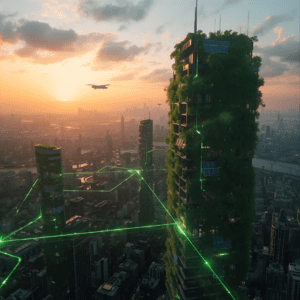
Caption: The smart city of the future uses AI to balance energy usage in real-time, integrating nature and technology.
1. The Smart Grid: AI as the Traffic Cop
The biggest problem with renewable energy (Solar and Wind) is that it is unreliable. The sun doesn’t always shine, and the wind doesn’t always blow.
In the old days, we kept coal plants running 24/7 just in case. Today, we use AI.
How It Works: Machine Learning models analyze weather patterns, historical data, and real-time usage to predict energy spikes before they happen.
-
If a cloud is about to cover a solar farm, the AI instantly reroutes power from a wind farm or a battery storage facility.
-
The Result: We can integrate massive amounts of renewable energy without the grid crashing, reducing our reliance on fossil fuels.
2. Green Data Centers: Cooling the Cloud
As we discussed in our Cloud Wars article, the internet lives in physical servers. These servers get hot—really hot. Cooling them accounts for nearly 40% of a data center’s total electricity bill.
The Tech Solution:
-
Liquid Cooling: Instead of blowing cold air (which is inefficient), modern servers are submerged in non-conductive fluids that absorb heat 1,000x better than air.
-
AI Optimization: Google used its DeepMind AI to control the cooling fans in its data centers. The AI learned to tweak the knobs so perfectly that it reduced the cooling energy bill by 40%. That is a massive reduction in carbon footprint, achieved purely through code.
3. Precision Agriculture: Growing More with Less
Agriculture is a huge source of carbon emissions and water waste. Enter the “Agri-Tech” revolution.
The Tech Solution:
-
Computer Vision: Tractors equipped with cameras and AI can see individual weeds. Instead of spraying an entire field with chemicals, the tractor sprays only the weed.
-
IoT Sensors: Soil sensors tell farmers exactly when a plant is thirsty. This prevents over-watering and reduces water usage by up to 30%.
This means cheaper food, less chemical runoff, and a healthier planet.
Caption: AI-powered drones scan crops to optimize water and fertilizer usage, reducing waste.
4. The Challenge: The Carbon Cost of Training AI
We must be honest. AI is not cost-free.
Training a massive model like GPT-4 requires thousands of powerful GPUs running for months. Some estimates suggest that training a single large language model emits as much carbon as five cars produce in their entire lifetimes.
The Fix: The tech industry is racing to build “Efficient AI.”
-
TinyML: A movement to run AI on small, low-power chips (like inside your phone) rather than massive supercomputers.
-
Green Coding: Developers are learning to write code that requires less processing power to execute.
Conclusion: A Symbiotic Future
Technology is a tool. A hammer can destroy a house, or it can build one.
For the first time in history, we have the tools to measure, analyze, and optimize our impact on the Earth in real-time. The “Green Algorithm” will not save us on its own—we still need policy and human will—but it gives us a fighting chance.
The future isn’t about choosing between nature and technology. It’s about using technology to understand nature better than ever before.