Introduction
Two years ago, we were amazed when an AI could generate a static image of a cat. Today, we are watching that cat run, jump, and star in a 60-second 4K movie trailer—all generated from a single sentence of text.
Welcome to the era of Generative Video.
In late 2025, tools like OpenAI’s Sora 2, Google’s Veo, and Runway Gen-4 have officially crossed the “Uncanny Valley.” They are no longer just making weird, morphing GIFs; they are producing commercial-grade footage that is indistinguishable from reality.
For marketers, this is a 10x productivity unlock. For indie filmmakers, it is the democratization of a billion-dollar industry. But for society, it raises terrifying questions about truth and reality.
This guide is your director’s chair. We will break down the top tools, the new “AI Filmmaking” workflow, and the ethical guardrails you need to know.
1. The Big Three: Choosing Your “Camera”
Just as photographers choose between Canon, Sony, and Nikon, AI directors must choose their model. As of late 2025, three titans dominate the market.
A. OpenAI Sora 2 (The Heavyweight)
-
Best For: Absolute realism and long takes (up to 60 seconds).
-
The “Wow” Factor: Sora understands physics. If a character drops a glass, it shatters correctly. It maintains “object permanence”—if a car drives behind a building, it re-emerges on the other side looking the same.
-
Cost: Expensive (bundled with ChatGPT Pro).
B. Runway Gen-4 (The Director’s Tool)
-
Best For: Professional control.
-
The Killer Feature: “Motion Brushes.” You can paint over a cloud and say “move left,” then paint over a car and say “move right.” Unlike Sora, which is a “black box,” Runway gives you granular control over every pixel.
-
Cost: Credit-based (Good for freelancers).
C. Pika Labs (The Social Viral)
-
Best For: Memes, social media, and anime styles.
-
The Vibe: Pika is fast, fun, and looser with reality. It excels at stylization (e.g., “Make this video look like a 90s cartoon”).
-
Cost: Freemium model.
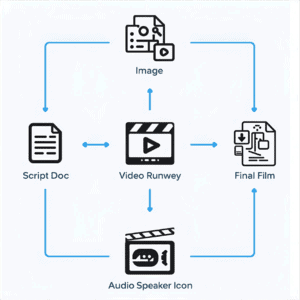
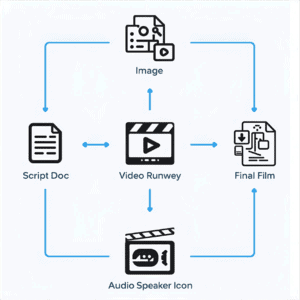
2. The New Workflow: How to Build an AI Movie
You don’t just type “Make a movie” and hit enter. To get professional results, you need a “Stack.”
Step 1: The Script (Claude / ChatGPT) Use an LLM to write your screenplay.
-
Prompt: “Write a 30-second commercial script for a luxury coffee brand. Break it down shot-by-shot.”
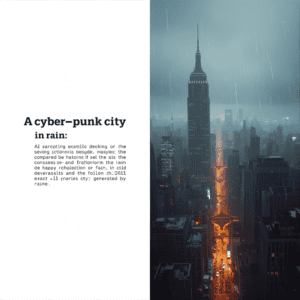
Step 2: The Storyboard (Midjourney) Don’t go straight to video. Generate Image Prompts in Midjourney first to define the “Look and Feel.”
-
Why: It gives you a “Reference Image” to ensure your character looks the same in every shot.
Step 3: The Animation (Sora / Runway) Upload your Midjourney images to Runway (Image-to-Video).
-
Action: “Camera pans slow right. Smoke rises from the coffee cup. Cinematic lighting.”
Step 4: The Sound (ElevenLabs + Suno) Video is dead without audio.
-
Voice: Use ElevenLabs to clone a narrator’s voice.
-
Music: Use Suno or Udio to generate a custom background track (“Lo-fi jazz, luxury vibe”).
Step 5: The Edit (Premiere / CapCut) Stitch it all together. AI generates the clips, but you are still the editor who tells the story.
3. The “Consistency” Problem
The biggest challenge in AI video is Character Consistency.
-
Scene 1: Your hero is wearing a red jacket.
-
Scene 2: The AI accidentally changes it to a blue jacket.
The Fix: Always use “Character Reference” (Cref) tags. In Runway or Sora, you can upload a “Sheet” of your character (front, side, back view) and tell the AI: “Use this specific character model.” Never rely on text descriptions alone.
4. The Ethics: Deepfakes & Watermarks
With great power comes great responsibility.
The “C2PA” Standard: By 2026, most major platforms (YouTube, TikTok, LinkedIn) will automatically label AI content. They do this by reading C2PA Metadata—an invisible digital watermark embedded in the file by Sora/Runway.
-
Warning: Never try to strip this metadata. It verifies that you are a legitimate creator, not a disinformation agent.
The Rule of Thumb: If you are depicting a real person (a celebrity or politician), stop. Even if it’s parody, the legal risks in 2025 are massive. Stick to fictional characters.
Conclusion: The Death of the “Budget”
In the past, a sci-fi movie cost $100 million because you needed sets, costumes, and CGI armies. Today, the only limit is your imagination and your GPU credits.
We are entering the age of the “One-Person Studio.” A single creative mind can write, direct, score, and edit a blockbuster from their bedroom. The tools are here. The question is: What story will you tell?