Introduction
For the last 70 years, “Artificial General Intelligence” (AGI) has been the Holy Grail of computer science.
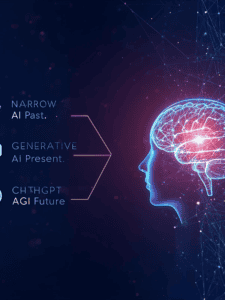
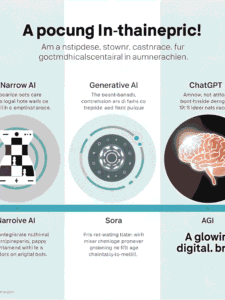
Current AI (like ChatGPT or Gemini) is what we call “Narrow AI.” It is incredibly good at specific tasks—writing code, summarizing emails, or generating images—but it lacks true understanding. It cannot reason like a human, it has no consciousness, and it cannot invent new physics.
AGI is different. AGI is a system that can learn any intellectual task that a human being can do. It is the moment when the machine becomes not just a tool, but a peer.
Silicon Valley insiders are quietly—and sometimes loudly—predicting that this moment is not decades away, but years away. Some say 2029. Some say 2027.
If they are right, everything we know about work, society, and economics is about to change. Here is the reality check on the countdown to the Singularity.
1. What is AGI, Really?
Don’t confuse “Advanced” with “General.”
-
Advanced AI: A calculator that can solve math problems 1,000,000x faster than you.
-
General AI: A system that can wake up, read the news, decide to learn French, write a novel, and then figure out how to cure cancer—all without being reprogrammed.
The “Coffee Test” Apple co-founder Steve Wozniak suggested a simple test for AGI: Can a robot enter a strange house, find the kitchen, figure out how to use the coffee machine, and make a cup of coffee? Right now, no robot on Earth can do this. AGI will.
2. The Bull Case: Why It’s Coming Soon
Why the sudden panic/hype? Because of Scaling Laws.
Researchers have discovered a frighteningly consistent rule: If you feed an AI model 10x more data and give it 10x more computing power, it gets predictably smarter. It hasn’t plateaued yet.
The Sam Altman (OpenAI) View: He believes that by simply building bigger supercomputers (like the rumored “Stargate” project), we will brute-force our way to AGI. We are already seeing “Reasoning Models” (like OpenAI’s o1) that pause and “think” before answering. This is the first step toward genuine problem-solving.
3. The Bear Case: The “Data Wall”
Not everyone agrees. Many experts (like Yann LeCun at Meta) argue that LLMs (Large Language Models) are a dead end.
The Argument:
-
LLMs are just “Autofill on Steroids.” They predict the next word. They don’t understand the physical world.
-
We are running out of data. We have essentially fed the entire internet to these models. There is no more text left to train them on. Without new data, progress might stall.
4. The Impact: Utopia or Obsolescence?
If AGI arrives in 2030, what happens to Tech Social readers?
The Economic Shift:
-
Cognitive Labor drops to Zero: If an AI can code, write, accounting, and legal work better than a human for $0.01/hour, the value of human cognitive labor collapses.
-
The “Human” Premium: Ironically, jobs that require physical dexterity (plumbers, nurses, electricians) might become the highest-paid professions, because robots are still clumsy.
The Social Shift: We will likely see the rise of “Universal Basic Compute”—where every citizen is guaranteed access to a powerful AI agent to help them navigate life, earning money, and managing health.
5. How to Prepare (Not Panic)
You cannot stop the wave, but you can learn to surf.
-
Become an “Integrator”: Don’t just learn to code; learn to manage AI coders. (See our AI Coding article).
-
Focus on “Why”, not “How”: The AI knows how to build the app. You need to know why the app should exist. Strategy, empathy, and philosophy are future-proof skills.
-
Stay Adaptable: The skill you learn today might be obsolete in 2 years. The ability to learn new skills quickly is the only skill that matters.
The Problem: This is a philosophical topic, so it’s hard to “test.” The Fix: Add a “Developer’s Perspective” to ground the theory in reality.
### Editorial: Why I’m Not Scared (Yet) As a Python developer, I work with these “super-intelligent” models every day. And here is a reality check that the news headlines miss: AI still struggles with basic logic.
Last week, I asked a leading AI model to refactor a Python dependency loop—a task a Junior Dev could solve in 20 minutes. The AI hallucinated a library that doesn’t exist (pip install fake-lib).
Until AGI can set up a local development environment, debug its own installation errors, and deploy code without me holding its hand, I don’t see it replacing human engineers. It will augment us, yes. But the “God-like” intelligence predicted for 2030 feels overly optimistic when you see the daily failures in the code editor.
Conclusion
Whether AGI arrives in 5 years or 50, the trajectory is clear. We are building a second species of intelligence.
The goal of Tech Social has been to guide you through this transition. By understanding the tools Generative AI, protecting yourself Cybersecurity, and looking ahead (Tech Trends), you are already ahead of 99% of the population.
The future is weird. Let’s explore it together.